
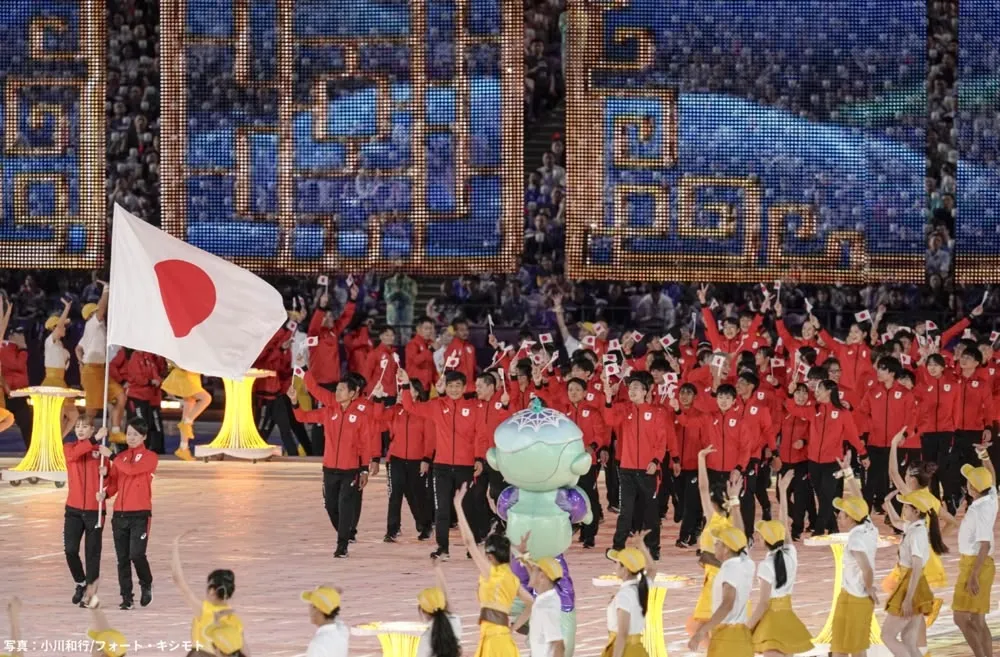
The 20th Asian Games officially began on Saturday, 19 September 2026, with a glittering opening ceremony in Nagoya, Japan. After a build-up marked by logistical challenges, the continental multi-sport event commenced at the Paloma Mizuho Stadium under the theme “Harmonic Heart Beat.” Athletes from across Asia marched into the venue as the host nation welcomed more than 11,000 competitors for 16 days of competition.
A Ceremony of Unity and Spectacle
The opening ceremony, directed by Japanese filmmaker Yukihiko Tsutsumi, was designed to convey solidarity among Asian nations through a blend of traditional culture, modern technology and symbolic storytelling. The theme “Harmonic Heart Beat” sought to represent the collective pulse of the continent at a time when regional sporting events often unfold against complex geopolitical backdrops.
The ceremony took place at the renovated Nagoya City Mizuho Park Athletic Stadium, also known as Paloma Mizuho Stadium. Starting at 6 p.m. local time (2:30 p.m. IST), the roughly two-hour programme featured cultural performances, the Parade of Nations and the formal declaration of the Games’ opening. Japanese dignitaries, including members of the imperial family, were expected to attend, underscoring the national significance of the occasion.
Japan is hosting the Asian Games for the third time, following Tokyo in 1958 and Hiroshima in 1994. The 32-year gap made the Aichi-Nagoya edition a landmark return for the country as a multi-sport host. Organisers had earlier combined the flames from the previous Japanese editions at Nagoya Castle before carrying the torch through municipalities in Aichi Prefecture, linking the present Games to the nation’s sporting history.
India’s Contingent and Flag-Bearers
India’s athletes entered the stadium led by two high-profile flag-bearers: double Olympic medallist shooter Manu Bhaker and kabaddi star Pawan Sehrawat. Bhaker’s selection was widely anticipated. She made history at the 2024 Paris Olympics by becoming the first athlete from independent India to win two medals at a single Games, securing bronze in both the individual and mixed team 10m air pistol events. Her presence at the forefront of the contingent symbolised India’s rising stature in precision sports.
Sehrawat stepped in as the male flag-bearer after a late change. Shot-putter Tajinderpal Singh Toor had originally been named alongside Bhaker. However, Toor’s ceremonial kit had not arrived in time, making it impractical for him to reach the venue for the parade. Sehrawat, a key member of the Indian men’s kabaddi team that won gold at the previous Asian Games, was chosen as the replacement. The kabaddi player described the honour as a moment of immense pride, while Bhaker reflected on how far she had come since her early days in the sport.
A substantial Indian contingent participated in the ceremony, representing the country’s broad medal ambitions across athletics, shooting, wrestling, kabaddi, hockey and other disciplines. For many athletes, marching behind the national flag marked the formal start of their campaign in what is Asia’s premier multi-sport gathering.
Challenges in the Build-Up
The opening ceremony arrived after a troubled preparatory period. Organisers faced criticism over accommodation and transport arrangements. Instead of constructing a traditional athletes’ village, the host authorities housed competitors and officials in a combination of hotel rooms, temporary wooden container units and a cruise ship docked in the bay. The cost-saving approach drew complaints from several teams about living conditions and logistical inconveniences.
Japan’s well-known reputation for efficiency came under scrutiny as these issues surfaced in the days leading up to the Games. Officials from the Olympic Council of Asia publicly defended the local organisers, noting that problems were being addressed and that the situation had stabilised once athletes settled in. The successful staging of the opening ceremony was seen as an opportunity to shift focus from the build-up difficulties to the sporting action itself.
Despite the challenges, the scale of the event remained impressive. More than 11,000 athletes from approximately 45 nations and regions were set to compete for hundreds of gold medals across 43 sports. Some disciplines had already begun competition before the formal opening, following the modern multi-sport practice of staggered schedules.
Significance for Asia and the Hosts
The Asian Games serve as both a high-level competitive platform and a diplomatic and cultural showcase. For Japan, hosting the event forms part of a broader ambition to strengthen its position in global sport and to demonstrate organisational capability after the unique circumstances of the Tokyo 2020 Olympics, which were held largely without spectators due to the pandemic.
The choice of Aichi Prefecture and Nagoya as the main hub highlighted regional development and the use of existing and upgraded infrastructure. The ceremony’s emphasis on harmony and shared heartbeat sought to project a message of continental unity even as individual nations pursued their own medal targets and national narratives.
For India, the Games represent a key milestone in the Olympic cycle. Performances in Nagoya will offer valuable competitive experience and ranking points ahead of future international assignments. The presence of established stars such as Bhaker alongside team-sport athletes like Sehrawat illustrated the diversity of India’s sporting strengths.
Looking Ahead to the Competition
With the opening ceremony complete, attention turns fully to the field of play. Over the next two weeks, athletes will contest medals in a wide range of Olympic and non-Olympic disciplines. Host Japan will be expected to challenge strongly across multiple sports, while traditional powerhouses and emerging nations will battle for supremacy on the overall medal table.
The success of the Games will ultimately be measured not only by the smoothness of the opening spectacle but by the quality of competition, the fairness of organisation and the experience provided to athletes and spectators. Early concerns about logistics have tested the organisers; the coming days will show how effectively those issues continue to be managed.
As the cauldron burned and the athletes prepared for their events, the 20th Asian Games formally entered its competitive phase. For the Indian contingent led by Manu Bhaker and Pawan Sehrawat, the march into the stadium marked both a moment of national pride and the beginning of a demanding campaign. The focus now shifts from ceremony to performance, as Asia’s best athletes compete for glory in Nagoya and beyond.
Read more – todaybestoffers.info
