
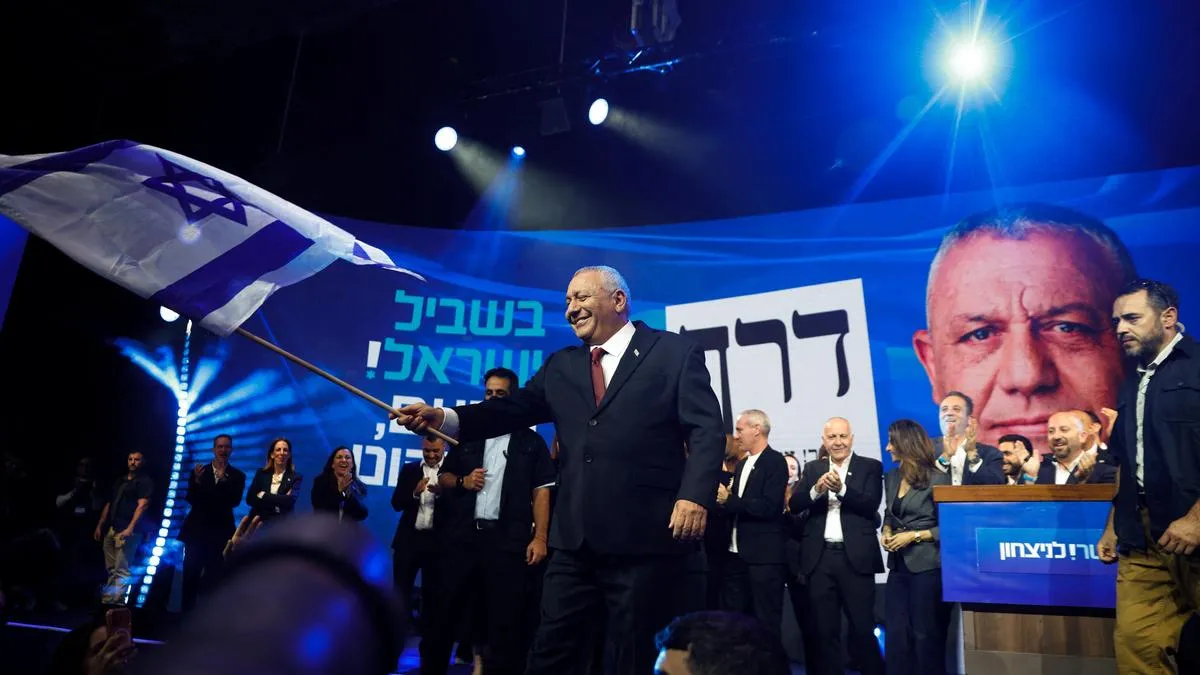
Israel’s latest election has produced a clear political stalemate. With the vast majority of votes counted, neither Prime Minister Benjamin Netanyahu’s ruling coalition nor the opposition alliance led by former military chief Gadi Eisenkot has secured the 61 seats required to form a government in the 120-member Knesset.
Current Seat Distribution
According to the latest tallies from the Central Elections Committee, Netanyahu’s bloc stands at 53 seats. This grouping includes Likud as the largest single party with around 26 seats, along with the ultra-Orthodox parties Shas and United Torah Judaism, and the far-right Otzma Yehudit and Religious Zionism parties.
Eisenkot’s alliance holds 48 seats. It comprises his Yashar party with approximately 21 seats, Naftali Bennett’s B’Yachad with about 12, the Democrats with eight, and Avigdor Liberman’s Yisrael Beytenu with seven.
The predominantly Arab parties—the Joint List and Ra’am—have secured a combined 19 seats, nearly doubling their previous representation and marking a record high. This leaves them holding significant potential influence in any coalition negotiations.
These figures, based on roughly 90 percent of ballots counted, leave both major camps well short of the majority threshold. Remaining double-envelope ballots from soldiers, diplomats and other absentees could still produce minor shifts, but the overall deadlock appears firm.
Why Neither Side Reached 61
Netanyahu’s coalition entered the election with a substantially larger presence in the outgoing Knesset and has suffered a notable decline. The drop reflects voter shifts and the challenges facing the long-serving prime minister after years of political and security pressures.
Eisenkot’s camp, positioning itself as a vehicle for change, also failed to consolidate enough support among Jewish parties to cross the majority line on its own. The surge in Arab voter turnout and the resulting seat gains for the Joint List and Ra’am have altered the arithmetic of possible governments.
In Israel’s multi-party system, forming a government almost always requires coalition-building. The absence of a clear majority for either of the two main blocs places the Arab parties in a potential kingmaker role, even as many Jewish parties have previously stated they would not rely on them for a governing majority.
Possible Scenarios Ahead
Several paths could emerge in the coming days and weeks as final results are certified and the president begins consultations with party leaders.
One scenario involves Netanyahu attempting to expand his 53-seat bloc by attracting additional partners. However, the limited number of remaining Jewish parties outside the two main camps makes this difficult without significant political concessions or shifts in allegiance.
Another possibility is that Eisenkot seeks to assemble a broader coalition that includes some or all of the Arab parties’ 19 seats. This would require overcoming longstanding political and ideological barriers, as several opposition leaders have publicly ruled out such partnerships during the campaign. A minority government relying on external support from Arab parties is also theoretically possible but would be inherently fragile.
A national unity government bringing together elements of both the Netanyahu and Eisenkot blocs remains another option, though deep personal and policy differences make it challenging. Failing any of these routes, Israel could face the prospect of another election if no viable coalition can be formed within the legal timeframe.
The Role of Arab Parties
The strong performance of the Joint List and Ra’am is one of the defining outcomes of this election. Higher turnout among Arab voters has given these parties greater parliamentary weight than in recent cycles. Their leaders have framed the result as a mandate to influence the direction of the next government and to push for change.
Whether Jewish parties are prepared to negotiate with them will be a central question in the post-election period. Past experiences of limited cooperation, such as Ra’am’s previous external support for a government, provide some precedent, yet the current political climate and campaign pledges create significant obstacles.
Next Steps in the Process
Once the final official results are published, the president will invite party leaders for consultations and then task the candidate judged most likely to form a government with the responsibility of doing so. That leader will have a set period, with a possible extension, to present a coalition that commands the confidence of the Knesset.
Both Netanyahu and Eisenkot have publicly stated their intention to form the next government. Negotiations are expected to be intense, involving discussions over policy priorities, ministerial portfolios and the fundamental composition of any ruling alliance.
Broader Implications
This election underscores the continued fragmentation of Israeli politics. High voter turnout, reported at around 77.7 percent, demonstrates strong public engagement, yet the result has not produced a decisive mandate for either major camp. The need for compromise, the influence of smaller parties, and the question of cooperation across traditional divides will shape the coming political phase.
For ordinary Israelis, the deadlock means a period of uncertainty while leaders attempt to translate election results into a functioning government. The process that follows will test the ability of rival factions to find common ground or, alternatively, to accept the need for another round of elections.
The coming days will clarify whether a stable coalition can be assembled or whether Israel is headed for prolonged political negotiations and potential instability. With neither Netanyahu nor Eisenkot holding a clear path to 61 seats on current numbers, the balance of power remains finely poised.
Read more – Aeshikshakosh.com
