
Devastating floods in Nepal have once again brought the question of climate compensation into sharp focus. After a glacial collapse triggered catastrophic flooding in the Rasuwa region, Nepal formally sought support from the international Loss and Damage Fund, arguing that it is paying a heavy price for a crisis it did little to create. The episode highlights long-standing debates about historical responsibility for greenhouse gas emissions, the purpose of the Loss and Damage Fund, and the gap between climate finance needs and available resources.
Nepal’s Case for Compensation
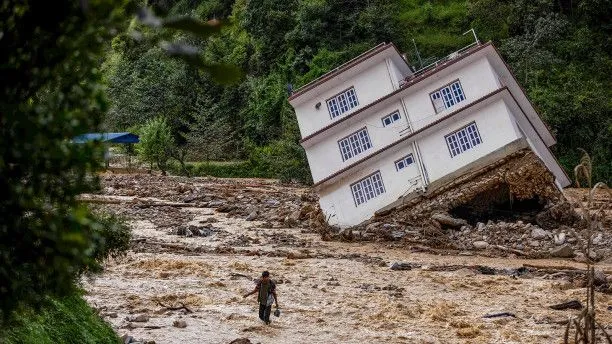
In late August 2026, a section of a Himalayan glacier collapsed, sending a torrent of water, mud and debris through valleys in Nepal and into neighbouring areas. The resulting floods and landslides caused widespread destruction of homes, roads, bridges, hydropower infrastructure and livelihoods. Official figures put the death toll in the thousands, with many more reported missing. Preliminary assessments indicated billions of dollars in physical damage.
Nepal responded by submitting a formal request to the Fund for Responding to Loss and Damage. The initial claim sought around $20 million in emergency support. Officials described the request as a first step, noting that a fuller assessment of losses would follow. Foreign Minister Shisir Khanal framed the demand in terms of climate justice rather than charity, emphasising that Nepal contributes a negligible share of global emissions—around 0.04 percent—yet faces severe and recurring climate impacts.
The letter, signed by senior ministers, urged the Fund’s board to consider an expedited response given the scale of the disaster and the time-sensitive nature of recovery needs. The appeal sits within a broader argument that countries with minimal historical and current emissions should not bear the full cost of climate-driven losses alone.
Historical Responsibility for Atmospheric CO₂
Understanding Nepal’s position requires looking at the cumulative contribution of different countries to the stock of carbon dioxide in the atmosphere. Cumulative emissions matter because CO₂ remains in the atmosphere for a long time and drives long-term warming.
Historically, the United States has been the largest cumulative emitter since the Industrial Revolution, accounting for a substantial share of total fossil-fuel and industrial CO₂ released to date. European nations, particularly the United Kingdom and other early industrialisers, also contributed heavily in the 19th and early 20th centuries. China’s cumulative total has grown rapidly in recent decades and now ranks second, reflecting its large population and industrial expansion. India ranks among the top current annual emitters but has a much smaller historical footprint on a per-capita and cumulative basis.
This distinction between cumulative and annual emissions lies at the heart of climate justice debates. Developing countries with low historical emissions argue that those who contributed most to the problem should provide finance and support for unavoidable losses and damages.
What the Loss and Damage Fund Is Designed to Do
The Loss and Damage Fund was established at COP27 in 2022 as part of the broader UN climate regime under the Paris Agreement. It was later operationalised and is intended to provide financial support to developing countries facing the irreversible impacts of climate change—impacts that cannot be avoided through mitigation or adaptation alone.
These impacts include extreme weather events, slow-onset processes such as sea-level rise and glacial retreat, and the economic and non-economic losses that follow. The Fund is meant to complement existing climate finance channels rather than replace them. Its early phase has focused on setting up governance structures, defining access modalities and opening initial funding windows.
In practice, the Fund has faced significant constraints. Pledges from contributing countries have totalled several hundred million dollars, yet the amount actually paid into the trust fund has been lower. Demand has far exceeded available resources. Early calls for proposals attracted requests running into the billions of dollars against a much smaller pool of committed and disbursed funds. Individual project grants in the start-up phase have been capped in the range of several million to around $20 million, limiting the scale of support any single country can receive in the first rounds.
The Fund’s board meets periodically to review proposals and make decisions. Emergency or out-of-cycle requests, such as Nepal’s, test the system’s ability to respond quickly to sudden disasters.
Connection to the COP Process
The Loss and Damage agenda has evolved through successive Conferences of the Parties. COP27 marked the political breakthrough that created the Fund. Subsequent meetings focused on operational details, governance, and the relationship between the Fund and other mechanisms such as the Warsaw International Mechanism for Loss and Damage and the Santiago Network.
At COP30, discussions continued on strengthening the overall Loss and Damage architecture. Progress included further work on the review of existing mechanisms, knowledge products on assessing economic and non-economic losses, and the launch of formal calls for funding requests under the Fund’s initial implementation modalities. However, the scale of finance remained a central point of contention. Developing countries continued to press for clearer pathways to scale up resources to levels closer to estimated annual needs, which run into hundreds of billions of dollars. Developed countries remained cautious about new quantified commitments.
The outcome left the Fund operational but still far short of the resources required to meet the volume of requests. This gap is precisely the context in which Nepal’s claim sits: a legitimate request under an established mechanism that currently lacks the depth of funding to respond at the scale of major disasters.
Beyond the Immediate Claim
Nepal’s $20 million request is modest relative to the overall damage estimates, which run into several billion dollars. Officials have acknowledged that the figure is only an initial ask and that broader recovery will require support from multiple sources, including multilateral development banks and bilateral partners. The Loss and Damage Fund is one instrument among several, but it carries particular political and symbolic weight because it is explicitly linked to the principle of addressing climate-related loss and damage.
The episode also illustrates the practical challenges of turning a political agreement into a functioning financial mechanism. Establishing eligibility criteria, ensuring rapid access, converting pledges into actual payments, and balancing competing demands from many vulnerable countries are all ongoing tasks. Until the Fund is capitalised at a much higher level and can disburse more quickly, countries hit by major climate-linked disasters will continue to face delays and shortfalls.
Why the Fund Matters
The Loss and Damage Fund matters because it represents an attempt to operationalise the idea that those least responsible for climate change should not be left to absorb its worst consequences alone. For countries such as Nepal, which sit on the front line of glacial melt, extreme rainfall and cascading disasters, the Fund is both a practical source of potential support and a recognition of differential responsibility.
Its effectiveness will ultimately be judged by whether it can move from limited pilot-scale grants to sustained, predictable and adequate finance. Nepal’s recent claim is an early test of that capacity. It also serves as a reminder that the science of climate impacts, the politics of historical emissions, and the design of international finance mechanisms are tightly interconnected. How the international community responds will shape not only recovery in one Himalayan nation but the credibility of the broader climate regime in the years ahead.
Read more – simplemarathiukhane.com
