
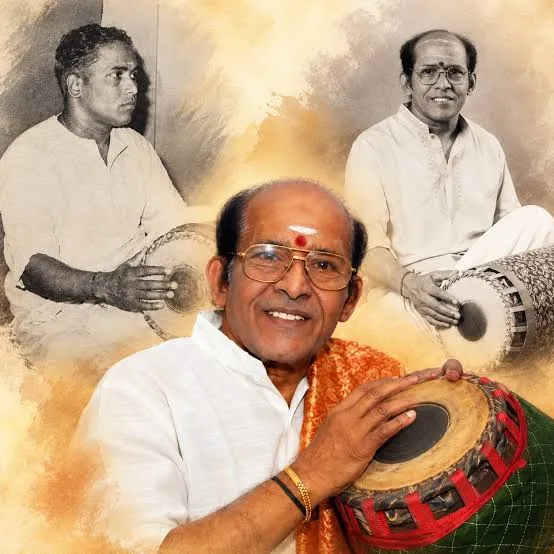
Guruvayur Dorai, the distinguished mridangam exponent, passed away on 10 October 2026 in Mylapore, Chennai, at the age of 91. Rooted in the Pudukkottai bani yet marked by a distinctly personal approach, he enriched countless Carnatic music concerts over eight decades and guided generations of students with quiet dedication.
Formative Years in Guruvayur
Born Vaidyanathan on 2 July 1935 in the temple town of Guruvayur, Kerala, to G.S. Krishna Iyer and Meenakshi, Dorai grew up in a family immersed in music. His father served as a priest, while the household included a sister, Guruvayur Ponnammal, who became a noted vocalist, and a brother, G.K. Rajamani, who excelled as a violinist.
At the age of five, Dorai contracted polio, which disrupted his formal schooling. His father encouraged him to channel his energy into the mridangam, recognising the child’s instinctive sense of rhythm. Early lessons began under Palghat Subba Iyer, followed by training with E.P. Narayana Pisharody. By the age of eight, Dorai made his concert debut accompanying the renowned vocalist Chembai Vaidyanatha Bhagavathar, an experience that launched a lifelong career on the stage.
Immersion in the Pudukkottai Tradition
A pivotal chapter unfolded through his association with Palani Subramaniam Pillai, a leading master of the Pudukkottai style. After meeting the senior artist and later studying under him in Madras, Dorai spent nearly nine years in the traditional gurukulavasam system at his guru’s residence. He absorbed the rhythmic complexities, tonal depth and accompanying sensibility of the Pudukkottai bani while retaining aspects of his own fingering technique.
This grounding allowed him to develop an original voice within the tradition. His playing became known for clarity, controlled power and an intuitive response to the main artist. The deep resonant effect known as gumki, produced on the left head of the mridangam, featured prominently in his style and was widely admired by peers and audiences alike.
A Career of Sensitive Accompaniment
Dorai’s greatest strength lay in his role as an accompanist. He possessed the rare ability to support and elevate a performance without drawing focus to himself. Over the decades he shared the stage with an impressive range of artists spanning several generations. These included Musiri Subramania Iyer, Semmangudi Srinivasa Iyer, M.D. Ramanathan, M. Balamuralikrishna, T.R. Mahalingam, G.N. Balasubramaniam and many others.
His long association with M.S. Subbulakshmi remains particularly memorable. Dorai accompanied her in numerous concerts, including the historic performance at Carnegie Hall in New York. His steady, responsive playing provided a firm rhythmic foundation that allowed the music to unfold with grace and depth.
He also performed with leading instrumentalists and later vocalists, demonstrating adaptability that kept his art relevant across changing times. Whether in major sabha concerts or more intimate settings, Dorai’s presence brought balance, precision and musical intelligence to the ensemble.
Teaching and Transmission
Beyond the concert platform, Dorai devoted considerable energy to teaching. He trained students in India and abroad, emphasising both technical mastery of the Pudukkottai style and the broader responsibilities of a percussionist. His approach stressed listening, discipline and respect for the musical context rather than mere display of virtuosity.
The Guruvayur Dorai Music Centre, established to promote the Pudukkottai tradition, reflects his commitment to passing on the knowledge he had received. Many of his students have gone on to become performing artists, carrying forward elements of his style and sensibility.
Recognition and Honours
Dorai’s contributions received significant institutional recognition. He was awarded the Kalaimamani by the Government of Tamil Nadu, the Sangeet Natak Akademi Award, the Sangeetha Kalasikhamani and the Sangeet Natak Akademi Tagore Ratna. In January 2025, the Government of India conferred the Padma Shri upon him, acknowledging a lifetime of dedicated service to the art of the mridangam.
Enduring Influence
Guruvayur Dorai’s life was shaped by rhythm from his earliest years. He overcame physical challenges, trained under demanding masters, and forged a distinctive path within a classical tradition. His performances enriched the experience of audiences for more than eight decades, while his teaching ensured that the insights he carried would continue through others.
In Carnatic music, the mridangam provides both structural clarity and expressive depth. Dorai exemplified the ideal of the accompanist who serves the music first. He listened deeply, responded with sensitivity, and maintained a quiet dignity on stage. As the music community reflects on his passing, the rhythms he shaped and the musicians he inspired remain a living continuation of his work.
His legacy rests not only in the concerts he elevated but in the generations of artists who absorbed his example of disciplined artistry, musical humility and unwavering commitment to the tradition.
Read more – Peopleinfoz.com
