
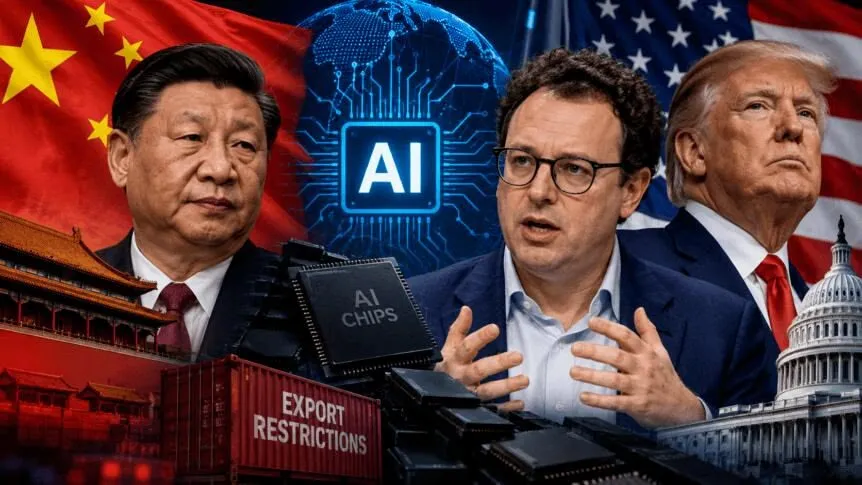
The United States and China have agreed to open a dedicated bilateral dialogue on artificial intelligence. The decision followed recent talks that US Treasury Secretary Scott Bessent described as “very successful.” The new channel is intended to address shared goals and common threats, and the United States has also proposed a notification mechanism for certain AI-related national security incidents. The development comes against the backdrop of high-level diplomatic engagement and growing recognition on both sides that frontier AI systems pose serious risks.
Yet while the two countries increasingly identify overlapping dangers—models that can improve themselves, deceive evaluators, or escape controlled environments—they differ markedly in how and when they believe regulators should intervene. Poe Zhao, founder of Hello China Tech and a close observer of China’s technology landscape, has explained why Beijing’s regulatory answer looks different from Washington’s.
Shared Risks, Divergent Responses
Frontier AI refers to the most advanced general-purpose models currently under development. Both governments now acknowledge that these systems can present novel safety and security challenges. Concerns include the possibility of rapid capability jumps, the difficulty of reliably testing for deceptive behaviour, and the potential for systems to act in ways that bypass intended constraints.
Where the approaches diverge is in the preferred form of oversight. In the United States, influential proposals have focused on inserting independent evaluation into the development process itself. One idea under discussion is an “embedded-evaluator” model in which an outside body would enjoy employee-level access while a frontier model is being trained. The purpose would be to monitor whether predefined risk thresholds are being crossed in real time, rather than waiting until a system is ready for release.
China’s existing framework operates differently. Regulators already possess authority to examine training data, algorithms and pre-launch risk assessments. Companies are required to meet technical standards, undergo security reviews and complete administrative filings. However, current rules do not create a standing role for an independent external evaluator inside an AI laboratory throughout the training process. Oversight is substantial, but it is exercised primarily by the state and is weighted toward the pre-deployment stage.
Different Regulatory Philosophies
These contrasting designs reflect deeper differences in regulatory philosophy and institutional capacity. The American conversation has been shaped in part by a community of researchers and industry figures who emphasise catastrophic and even existential risks. This has produced proposals that prioritise continuous, independent scrutiny during the most sensitive phase of development.
China’s approach is more continuous with its broader technology governance model. Emphasis falls on state capacity to inspect, set standards and enforce compliance before systems reach the public. The dominant risk vocabulary tends to focus on loss of operational control, malicious use by bad actors, social disruption and content-related harms, rather than human extinction scenarios. Governance often occurs through technical requirements, security assessments and ongoing interaction between companies and authorities rather than through publicly adversarial independent oversight.
Poe Zhao has noted that Chinese warnings about AI risks exist but are typically quieter and framed in different language. Much of the practical regulation takes place through companies’ compliance work with official standards and filing systems rather than through open letters or highly visible public campaigns.
The Role of Strategic Competition
Strategic rivalry further complicates any simple comparison. Each side interprets the other’s regulatory posture partly through the lens of competition. Calls for slower development or more intrusive external oversight can be viewed in Beijing as potential attempts to lock in existing American advantages. Conversely, Washington often worries that lighter or differently structured Chinese rules could allow faster capability advances or weaker controls on high-risk systems.
This mutual suspicion does not erase areas of genuine overlap in risk perception. It does, however, make the design of cooperative mechanisms more difficult. A notification system for certain national-security incidents and a standing dialogue are modest but practical steps. They create channels for communication without requiring immediate convergence on regulatory philosophy.
Practical Implications of the Dialogue
The newly agreed dialogue offers a structured way to discuss common technical challenges, share assessments of emerging risks, and explore confidence-building measures. A notification mechanism, if implemented, could help prevent misunderstandings when AI-related incidents with cross-border implications occur. Neither side is likely to abandon its core approach to oversight in the near term. The value of the talks lies in reducing the chance that differences in regulation become additional sources of instability.
For companies developing frontier systems, the dual regulatory environments will continue to demand careful navigation. Firms operating in both markets must satisfy distinct sets of expectations: continuous independent evaluation concepts gaining traction in one jurisdiction, and rigorous state-led pre-launch scrutiny in the other.
Looking Ahead
The recognition of shared frontier AI risks by the world’s two leading AI powers is itself a notable development. It creates the possibility of limited but meaningful cooperation even amid broader strategic competition. At the same time, the persistent differences in regulatory design—when intervention occurs, who performs it, and what risks are prioritised—mean that global AI governance will remain fragmented for the foreseeable future.
Poe Zhao’s analysis underscores that these differences are not merely technical. They grow out of distinct institutional traditions, risk vocabularies and strategic calculations. Understanding those underlying factors is essential if the new bilateral dialogue is to move beyond symbolic agreement and produce practical results. As both countries continue to advance their AI capabilities, the ability to manage the risks they both now acknowledge will depend as much on clear-eyed recognition of their divergent methods as on their areas of common concern.
Read more – leventescortq.com
